)
Sustainable business
27.07.2026
Webinar recap: How businesses can build a credible biodiversity investment strategy
Earthly brought together Lorienne Whittle, Rewilding Landscapes Manager at Nattergal ; Siobhan Stewart, Head of Delivery at …

)
A study by the European Commission found that
of environmental claims made by businesses were vague, misleading, or unfounded - highlighting the growing gap between sustainability communication and substantiated environmental action.
Businesses are now required to communicate their climate action without sounding vague, misleading, or performative. This is why leading companies are turning to verified nature-based solutions that have verifiable impact reporting data to strengthen their sustainability communication.
Most greenwashing is not deliberate, it happens when claims lack evidence.
Regulations such as the EU’s Empowering Consumers for the Green Transition Directive and the UK’s Green Claims Code are increasing pressure on businesses to substantiate environmental claims.
A defensible claim requires a recognised standard, third-party verification, clear scope, and measurable outcomes.
Earthly's Keystone 3.0, Impact Dashboard, Customer Hub, and Biodiversity Ledger help businesses make credible sustainability claims.

According to the 2023 Green Buying Report, over 70% of consumers are willing to pay a premium for sustainably produced goods. This eco-conscious purchasing trend is driven heavily by younger generations, specifically Gen Z at 82% and Millennials at 79%.
Sustainability claims are statements businesses make about the environmental or social impact of their products, services, operations, or wider business practices. These claims are used to communicate sustainability efforts to consumers, investors, regulators, employees, and other stakeholders.
The claims can appear across product packaging, company websites, marketing campaigns, ESG and sustainability reports, investor communications, advertising materials, and procurement documents:
Carbon neutral
: Claiming emissions from a product, project or organisation are fully balanced or eliminated.
Climate positive
: Claiming a business or product removes more carbon from the atmosphere than it emits.
Net zero
: Claiming emissions have been fully reduced and any residual emissions are offset.
Sustainably sourced
: Claiming materials are responsibly sourced with full traceability.
Renewable energy powered
: Claiming an entire business runs on renewable energy.
Plastic-free
: Claiming no plastic use in packaging, supply chains or components.
Biodegradable
: Claiming a product naturally breaks down.
Sustainability claims help businesses communicate environmental action, demonstrate accountability, and respond to growing expectations around climate and sustainability. Credible sustainability communication can strengthen stakeholder trust, support ESG reporting, improve transparency, and help businesses differentiate themselves in sustainability-conscious markets.
Businesses should communicate sustainability efforts transparently, accurately, and with evidence that can withstand scrutiny.
Sustainability messaging has increased over the past decade. However, without transparency, standardised reporting, and verifiable data, these sustainability claims can easily become confusing and misleading.
Consequently, things are changing:
The
Empowering Consumers for the Green Transition Directive (ECGT)
has applied across the EU since 27 September 2026. It sets clearer rules for how businesses communicate their environmental credentials:
Generic environmental claims
, such as "eco-friendly" or "environmentally friendly," are only permitted where businesses can demonstrate recognised excellent environmental performance.
Product claims of neutral, reduced or positive climate impact based on offsetting
, such as "climate neutral" or "carbon neutral" labels, are no longer permitted.
Sustainability labels
must be based on a certification scheme or established by public authorities.
For businesses investing in climate and nature projects, this is a chance to communicate that action more precisely, by describing the verified impact they've funded rather than claiming neutrality.
In the UK, the Competition and Markets Authority (CMA) and Financial Conduct Authority (FCA) have intensified scrutiny around sustainability communication.
The two frameworks set clear expectations for how businesses communicate on sustainability:
:
Requires that all environmental claims are truthful, accurate, and substantiated. Claims must not omit material information, must be clear about what they cover, and must be verifiable at the point they are made.
:
Requires financial products and firms to back sustainability-related labels and claims with evidence, prohibits misleading sustainability claims in financial promotions, and sets naming and marketing rules for investment products.
Beyond regulation, greenwashing now carries legal, reputational and commercial risk.
In April 2025, the Frankfurt State Prosecutor’s Office fined asset manager DWS
for overstating its ESG credentials - one of the largest greenwashing penalties in the financial sector to date. Greenwashing cases can now carry fines of up to
of annual revenue in some jurisdictions.
Consumer skepticism is also rising. Today,
of consumers believe companies engage in greenwashing, up from just a third in 2023, while
of UK consumers say they are willing to boycott brands over misleading environmental claims.
is the practice of making environmental or sustainability claims that are misleading, exaggerated, unsubstantiated, or lacking important context. In many cases, greenwashing occurs when businesses present themselves as more environmentally responsible than they can credibly prove.
Terms like “sustainable,” “eco-friendly,” “green,” or “climate positive” are often used without clearly defining what they mean or how they are measured. Since these claims are not tied to a recognised standard, metric, or methodology, they can easily mislead consumers and create confusion around a company’s actual environmental impact.
Claims such as “100% sustainable” or “zero emissions” can create risk if businesses cannot fully substantiate them across their operations and supply chains. Absolute statements often oversimplify complex environmental realities and may imply a level of impact reduction that has not actually been achieved.
One of the most common forms of greenwashing is selectively promoting a single environmental initiative while omitting impacts elsewhere in the business. For example, a company may heavily market recyclable packaging while failing to address high supply chain emissions, resource consumption, or lack of a credible transition strategy.
Claiming “carbon neutrality” or “net zero” based solely on carbon offsetting is becoming a high-risk area. This is especially true where carbon credits lack additionality, permanence, transparency, or third-party verification.
Making claims about future sustainability targets, science-based alignment, biodiversity impact, or environmental outcomes without clear evidence behind them. Sustainability claims must be supported by measurable data, transparent reporting, and credible evidence showing how targets or impacts will actually be achieved.
Sustainability certifications and eco-labels can help strengthen credibility, but only when they are used transparently and accurately. Misrepresenting what a certification covers, applying labels too broadly, or failing to explain verification standards can mislead consumers and weaken trust in environmental claims.

According to the World Economic Forum, nature-based solutions can deliver up to 37% of the emissions reductions required by 2030. This climate strategy simultaneously drives ecosystem restoration, biodiversity recovery, and improves livelihoods for local communities.
For teams responsible for communication of sustainability performance, the following principles apply:
Claims should focus on measurable outcomes that stakeholders can understand and verify.
For example, saying a business has “reduced emissions by 35% since 2021” is far more credible than simply claiming to be “committed to sustainability.” Wherever possible, include:
Quantifiable data
Timeframes
Scope of impact
Clear environmental metrics
Specificity helps reduce ambiguity and builds greater trust with consumers, investors, and regulators.
Sustainability claims should always be supported by credible evidence:
A recognised standard:
The underlying investment or activity is measured against an established methodology - one with defined criteria, additionality requirements, and monitoring obligations. In nature-based solutions, this includes standards such as Verra VCS, Gold Standard, and Plan Vivo.
Third-party verification
: The claim is not self-certified. An independent body has assessed the activity against the stated standard and confirmed it meets the required criteria.
Clear scope
: The claim defines precisely what it covers - which activities, which emissions, which time period - and does not imply broader performance than the evidence supports.
Measurable outcomes
: The impact is quantified and traceable. Not 'we support reforestation' but a specific number of verified tonnes of carbon removed or hectares of habitat protected, against a defined baseline.
Businesses should focus first on reducing operational and supply chain emissions before relying heavily on offsetting claims.
A credible sustainability strategy should demonstrate:
Clear emissions reduction efforts
Long-term decarbonisation plans
Investment in operational improvements
Transparent treatment of residual emissions
Offsetting can still play an important role, particularly for hard-to-abate emissions, but it should complement, not replace, climate action.
No sustainability strategy is perfect, and businesses build more trust when they communicate openly about both progress and challenges.
This may include clarifying the following in your reports:
Which emissions scopes are included
Baseline years and reporting periods
Boundaries of environmental claims
Areas where improvements are still ongoing
Transparency helps businesses avoid overstating impact while demonstrating accountability and long-term commitment.
The World Economic Forum estimates that a transition to a nature-positive economy could generate over $10 trillion in annual business opportunities. Investing in
helps businesses capture that opportunity while delivering measurable outcomes across climate, biodiversity, and communities.
Businesses need confidence that the environmental projects they support can withstand scrutiny. High impact biodiversity initiatives and carbon projects provide:
Measurable environmental outcomes
Transparent methodologies
Long-term stewardship plans
Independent verification
Traceable reporting on climate and biodiversity impact
Businesses that support credible, evidence-backed projects are in a stronger position to communicate sustainability efforts responsibly and strengthen stakeholder trust over time.
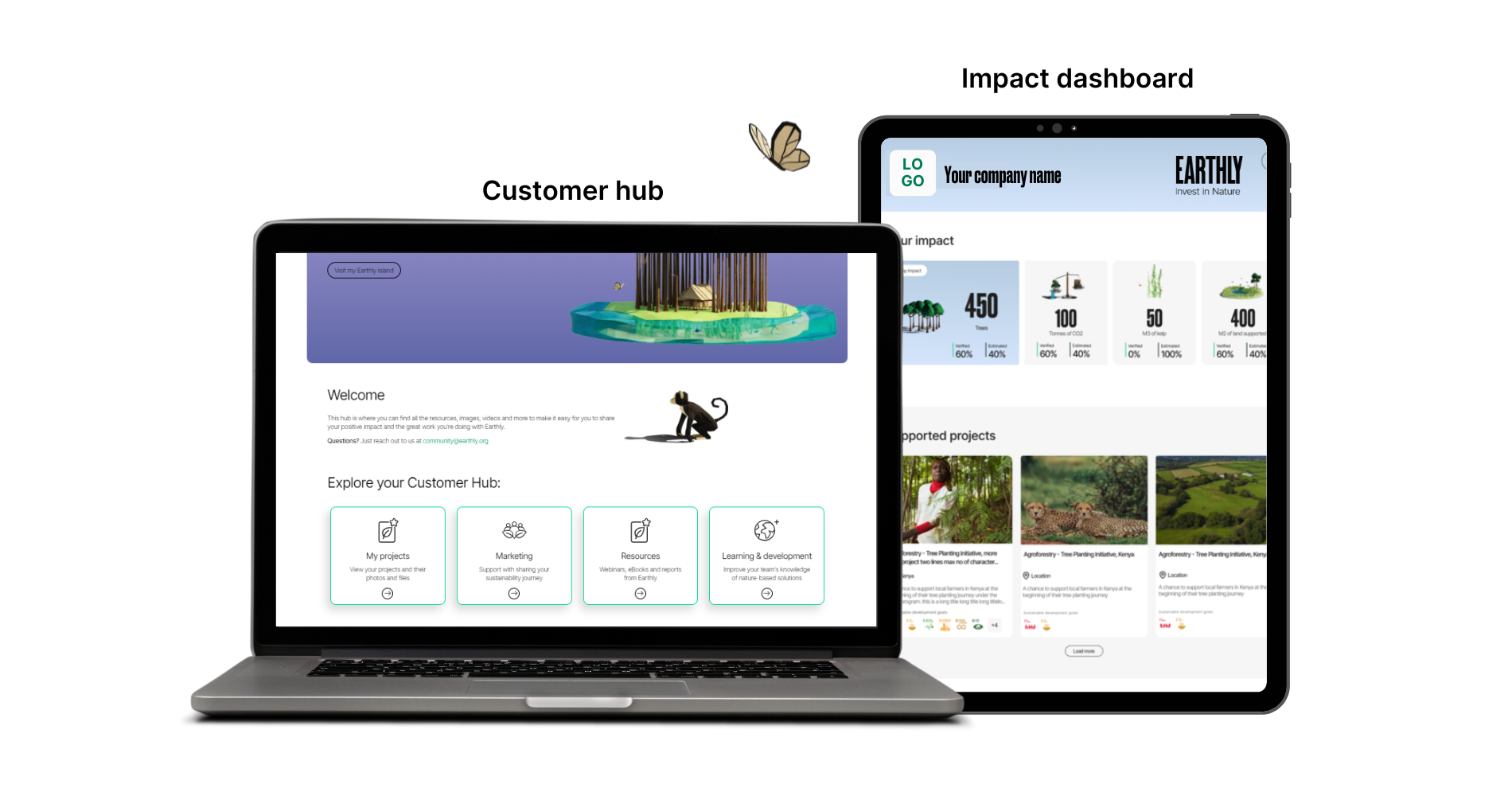
Overview of Earthly’s Customer Hub and Impact Dashboard, giving businesses access to project information, sustainability resources, and consolidated climate, biodiversity, and community impact data across the NbS projects they support.
The strongest claims describe what your business actually did, where, how much, and who verified it.
Before any claim goes live, check that it:
Names the specific project, standard and verifier.
Includes a number, timeframe and scope.
Describes a contribution rather than claiming neutrality.
Can be backed up with documentation if a regulator or customer asks.
Instead of:
"This product is carbon neutral."
Try:
"For every product sold, we fund the removal of [X] kg of CO₂e through [project name] in [country], verified under Verra VCS."
Under the ECGT, product claims of neutral or reduced climate impact based on carbon credits are no longer permitted in the EU. Describing your contribution keeps the message clear and credible.
Instead of:
"We're a climate positive business."
Try:
"In 2026, we supported [X] verified tonnes of CO₂e removals across [number] nature-based projects, alongside reducing our operational emissions by [X]% since [year]."
Instead of:
"We have offset all our emissions."
Try:
"Beyond our emissions reduction targets, we contributed to [X] tonnes of verified carbon removals and reductions through projects certified under Verra VCS and Gold Standard. Our Scope 1 and 2 emissions are included; Scope 3 reporting is in progress."
Instead of:
"This is a carbon neutral event."
Try:
"We measured this event's footprint at [X] tonnes of CO₂e and funded an equivalent volume of verified carbon removals through [project name]."
Instead of:
"We're nature positive."
Try:
"We're supporting the restoration of [X] hectares of [habitat] at [project name], tracked through [X] voluntary biodiversity credits recorded on Earthly's public Biodiversity Ledger."
Instead of:
"Shop with us and help save the planet."
Try:
"For every order this month, we'll fund one mangrove tree at [project name] in [country], supporting coastal protection and local livelihoods."
Instead of:
"We're a net zero company."
Try:
"We've committed to reaching net zero by [year], in line with the SBTi Corporate Net-Zero Standard. Since [baseline year], we've reduced emissions by [X]%, and we're investing in verified climate projects beyond our value chain."
Earthly helps businesses strengthen sustainability communication through verified nature-based projects, transparent reporting, and traceable environmental impact data:
Earthly experts work with your business to understand any claims you would like to work towards, your environmental ambitions and your reduction goals. Then, we'll recommend the right nature-based projects and investment levels to match.
Every project is assessed through Earthly’s
, which evaluates factors such as additionality, permanence, transparency, risk, and long-term stewardship to help ensure environmental integrity and credibility.
Projects
are also verified against recognised standards including Verra VCS, Gold Standard and Plan Vivo, helping businesses substantiate claims and support reporting aligned with frameworks such as IFRS S2, TNFD and CSRD..
The
is a public registry of all biodiversity credits issued through Earthly. Every credit is tied to a precise plot of land, anchored by geospatial coordinates, and recorded with an immutable, time-stamped entry that cannot be removed or altered.
For businesses navigating TNFD disclosures or communicating biodiversity action to stakeholders, the ledger provides the transparency, accountability, and supporting evidence needed to make sustainability claims.
Leading disclosure frameworks, including CSRD, ISSB (IFRS S2) and TNFD, expect businesses to report with quantified, evidence-backed data.
Earthly’s
provides businesses with consolidated impact data linked to the projects they support across the Earthly portfolio.
This includes climate, biodiversity, and community impact metrics that reflect the measurable outcomes of a business’s contributions and can be used directly in ESG disclosures, annual reports, sustainability communications and stakeholder reporting.
Earthly's
centralises project information, impact data and communication resources in one place - reducing the internal complexity of managing nature investment and making it easier to produce consistent, accurate sustainability communications across disclosures and stakeholder reports.
Earthly supports businesses with guidance and resources designed to help teams communicate sustainability initiatives more clearly, accurately, and transparently around:
Sustainability messaging
Environmental claim communication
Project storytelling
ESG and disclosure communication
Stakeholder-facing sustainability content
We also have webinars, project demos, newsletters, and educational content designed to help businesses communicate climate and biodiversity action effectively.
If your business is looking to support verified climate and biodiversity projects backed by measurable impact and transparent reporting, explore
or
about building a sustainability strategy and communication approach you can confidently stand behind.

Products that back up their marketing with credible ESG (Environmental, Social, and Governance) claims achieve 28% cumulative sales growth over a five-year period, compared to 20% for products without them - McKinsey and NielsenIQ retail tracking study.
Can businesses make sustainability claims about supporting nature-based solutions?
Yes, nature-based solutions are often some of the strongest and most credible sustainability initiatives businesses can invest in and communicate to stakeholders about. They provide visible, measurable environmental and community impact that resonates strongly with stakeholders.
However, these claims must still be backed by measurable impact, transparent reporting, and credible verification.
Can businesses make sustainability claims without third-party verification?
In some cases, businesses can make sustainability claims without third-party verification, but independently verified claims are generally viewed as more credible and lower risk.
What are the risks of making misleading sustainability claims?
Misleading sustainability claims can expose businesses to regulatory investigations, legal disputes, reputational damage, and loss of stakeholder trust.
What kind of evidence should support sustainability claims?
Businesses should support sustainability claims with measurable data, transparent methodologies, reporting frameworks, project documentation, and, where possible, independent verification.
Related articles
27.07.2026
Earthly brought together Lorienne Whittle, Rewilding Landscapes Manager at Nattergal ; Siobhan Stewart, Head of Delivery at …
)
08.07.2026
Eight in ten companies reporting on sustainability are now doing it across more than one framework simultaneously …
)
18.06.2026
On 11 June 2026, the Science Based Targets initiative (SBTi) published the final Corporate Net-Zero Standard …