)
Sustainable business
27.07.2026
Webinar recap: How businesses can build a credible biodiversity investment strategy
Earthly brought together Lorienne Whittle, Rewilding Landscapes Manager at Nattergal ; Siobhan Stewart, Head of Delivery at …

)
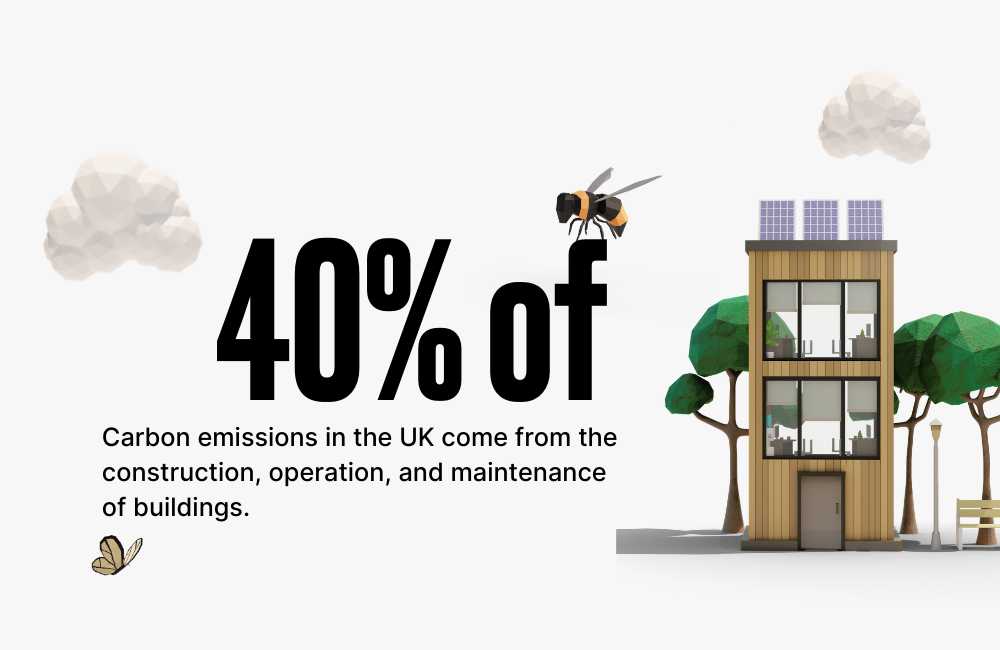
The construction and building sector currently accounts for approximately
of global energy-related carbon emissions, with embodied carbon representing roughly 11% of annual greenhouse gas emissions worldwide. This means businesses in the built industry must prioritise reducing embodied carbon, improving material choices, and plan how to address residual emissions as part of their
strategies. In practice, this requires a combination of low-carbon design, robust carbon measurement, and a defined approach to managing outstanding emissions.
Embodied carbon is the built environment's fastest-growing compliance challenge
The UK Net Zero Carbon Buildings Standard sets tightening carbon limits across 15 building sectors. Version 1 launches in early 2026.
Two net zero compliance routes exist for construction: offset at completion (net zero delivery) or meet defined limits with early credit acquisition (net zero aligned).
Carbon pricing in construction has long operated on guesswork - figures drawn from industry rumour, outdated benchmarks, or regional averages that rarely reflect the specifics of a project. As a result, budgets are built on assumptions; clients face unexpected costs at handover; and net zero claims become difficult to defend when challenged.
Currently, across the industry, frameworks such as the
are introducing clearer definitions, measurable limits, and verification requirements for both embodied and operational carbon. With Version 1 expected in 2026, developers will be required not only to measure emissions, but to demonstrate how they are reduced and how any remaining emissions are addressed.
At the same time, we are seeing expectations from investors, clients, and planning authorities are becoming more stringent. Net zero is now treated as a verifiable, auditable outcome.
Reducing emissions gets projects part of the way to net zero, but developers still need a clear plan for what remains, especially as regulatory requirements tighten and clients demand credible net zero credentials.
refers to the greenhouse gas emissions associated with the materials and processes used to construct a building (or structure) throughout its lifecycle. This includes emissions generated during raw material extraction, manufacturing, transportation, construction, maintenance, and eventual demolition or disposal.
For years, the industry's decarbonisation focus fell almost exclusively on operational carbon - the emissions from heating, cooling, and powering buildings once they were in use. That focus was understandable because operational carbon is measurable, manageable, and responds directly to well-understood interventions like insulation, heat pumps, and renewables.
However, as energy systems decarbonise and shift towards low- or zero-carbon sources - and building performance improves - embodied carbon is now being recognised as part of a building’s total footprint. The
warns that embodied emissions are on track to account for around half of the total carbon footprint of new buildings by 2050 if left unaddressed.
These emissions are largely driven by the production and use of construction materials, including:
Concrete and cement
Structural steel and aluminium
Glass
Insulation and mechanical systems
They also include emissions from transporting materials, construction activities, and the ongoing maintenance and replacement of building components.
For many modern buildings, particularly those designed to be energy efficient, embodied carbon can represent a large share of total lifetime emissions. In some cases, it accounts for
of a building’s overall carbon footprint. This means that even if a building operates efficiently, a BIG portion of its climate impact may already be locked in at the point of construction.
A net zero building is one that minimises carbon emissions across its entire lifecycle and addresses any remaining emissions to achieve a net zero carbon impact.
This requires action across two key areas:
Operational carbon:
Reduce energy demand through efficient design, optimise building performance, and transition to low- or zero-carbon energy sources.
Embodied carbon:
Minimise material-related emissions through low-carbon design, responsible sourcing, and early-stage carbon assessments, and plan how any remaining emissions will be addressed.
These actions ensure emissions are reduced as far as possible, with any remaining impact clearly measured and addressed.
The UK Net Zero Carbon Buildings Standard is a built environment industry-led framework that defines what it means for a building to be “net zero carbon aligned” across its lifecycle - covering both operational and embodied emissions.
The framework was developed by organisations including UKGBC, RIBA, RICS, and IStructE, to bring consistency, transparency, and credibility to how net zero buildings are measured and verified in the UK.
Although it's currently in its pilot phase, it introduces a more rigorous and structured approach to carbon accountability. Projects are expected to:
Carry out a full lifecycle embodied carbon assessment
Use as-built data, rather than design-stage estimates
Rely on product-specific Environmental Product Declarations (EPDs) where available
Demonstrate alignment with defined carbon limits and reporting requirements
Undergo independent verification to support net zero claims
Version 1 of the Standard is expected at some point in 2026, at which point these requirements are likely to become more widely adopted across the industry.
To meet the UK Net Zero Carbon Buildings Standard, projects must demonstrate, with verified data, how emissions have been reduced and how any remaining emissions are addressed.
This means developers should:
Integrate carbon assessments earlier in the design process
Work more closely with supply chains to access reliable data
Plan for residual emissions and how they will be managed
Ensure that net zero strategies can stand up to external scrutiny
As frameworks like UKNZCBS gain traction, the ability to deliver credible, evidence-based net zero buildings will become a key differentiator, influencing planning approval, investor confidence, and client decision-making.
Currently, developers are taking two main routes to manage carbon as part of net zero delivery, defined by when and how they engage with carbon markets:
In this case, all remaining emissions are offset once construction is finished, allowing for a clear and immediate
net zero claim
.
While it's simple to implement, it introduces pricing and supply risk. Carbon credit markets are volatile, and demand for high-integrity credits is increasing. For projects with multi-year timelines, delaying procurement makes final costs difficult to predict and leaves developers exposed to rising prices.
Other developers adopt a
net zero aligned strategy
, planning how to address emissions over a longer timeframe rather than at a single point in time.
This may involve purchasing credits in advance, securing future supply, or hedging against expected increases in carbon prices. Developers who take this route can integrate carbon costs into their broader financial planning and reduce exposure to market volatility.
This strategy offers greater flexibility, but it also requires a more proactive and informed approach to carbon markets.

Urban biodiversity is on the rise, with a 52% increase in bee sightings per kilometre since 2010, supporting the UK’s goal to protect 30% of land for nature by 2030 and integrate nature into urban spaces.
Even with low-carbon design strategies and careful material selection, most buildings still produce some level of unavoidable emissions. These residual emissions must be addressed to achieve
.
In practice, this means turning to carbon markets, where developers purchase credits that fund projects designed to remove or avoid emissions elsewhere.
Carbon pricing
refers to the financial cost of doing this - the cost of compensating for emissions that cannot be eliminated through design and construction alone.
However, pricing carbon is far from straightforward. Carbon credits vary significantly in quality, methodology, and location. These differences directly affect both cost and credibility, yet many projects still rely on simplified assumptions - applying a single price per tonne that does not reflect real market conditions.
As a result, carbon is often mispriced in project budgets. Costs are either underestimated - exposing developers to risk at completion - or overestimated, limiting investment and distorting decision-making.
As part of net zero requirements, developers are now expected to address residual emissions in their construction work, and to demonstrate that the carbon credits used are credible and high quality.
Not all credits are equal. Differences in methodology, verification standards, and long-term impact mean that choosing the right type of project is critical to delivering credible net zero outcomes.
- such as reforestation, afforestation, and ecosystem restoration - are actions that protect, restore, or manage natural ecosystems. They provide measurable carbon impact while also delivering benefits for biodiversity, communities, and ecosystem resilience, aligning with broader sustainability goals.
However, selecting the right project requires careful
to provide credible impact. Developers should prioritise
that demonstrate:
Strong verification and certification under recognised standards like Plan Vivo, Gold Standard and VERRA.
Long-term permanence, ensuring carbon is stored over meaningful timeframes
Additionally, meaning the project would not have happened without carbon finance
Clear monitoring, reporting, and transparency around impact
Measurable co-benefits, such as biodiversity enhancement and community outcomes
Earthly has
over 1,000 carbon projects globally, with only a small proportion meeting the criteria required for inclusion in our marketplace. Each project on our
is rigorously evaluated across 160+ data points, including verification, permanence, additionality, and co-benefits, to ensure the highest level of integrity. As a result, developers can confidently select projects that deliver measurable carbon impact alongside biodiversity and community value.

Woodland regeneration, Scotland - a nature-based project that combines long-term carbon sequestration with biodiversity restoration, offering high-integrity credits for net zero investment.
The World Green Building Council has set a clear industry target: by 2030, all new buildings and major retrofits should achieve at least a
reduction in embodied carbon. Current research suggests that while the technical pathways to achieve this exist through low-carbon materials, circular design strategies, and digital optimisation, the industry is not yet on track to meet them at scale.
As a result, nature-based solutions are likely to act as a complementary mechanism - helping to address residual emissions while the industry continues to scale decarbonisation efforts.
Carbon markets respond to demand. As 2030 compliance deadlines approach and the verified carbon credit supply for high-integrity projects remains finite, prices will rise. Developers who understand their carbon exposure now and who build offset costs accurately into their financial models will be better positioned to meet their net zero goals.
Earthly works with developers and project teams to address one of the least defined parts of net zero delivery: how to price embodied carbon and procure carbon credits with confidence.
We combine carbon market expertise with practical tools and project access to support real-world decision-making. We support the built environment sector to invest in high-integrity,
, that are aligned with long-term net-zero goals.
Our solutions help developers build net zero strategies on a clear, defensible foundation.
if you are working on a building project and need a clearer view of what net zero alignment will require.

View of the habitat restoration project in Timsbury, UK - restoring meadows, woodland, and wetlands to enhance biodiversity and reconnect natural water systems.
What is embodied carbon in buildings?
Embodied carbon refers to the greenhouse gas emissions associated with the materials and construction processes of a building across its lifecycle, including extraction, manufacturing, transport, construction, and eventual disposal.
What is a net zero carbon building?
A net zero carbon building is one that reduces emissions as much as possible and addresses any remaining emissions, typically through high-integrity carbon credits, in line with frameworks such as the UK Net Zero Carbon Buildings Standard.
Why is carbon pricing important for net zero buildings?
Carbon pricing determines the cost of addressing residual emissions. Without clear pricing, developers cannot accurately budget, plan, or deliver credible net zero strategies.
How do developers address residual emissions?
After reducing emissions through design and material choices, developers typically address remaining emissions by purchasing carbon credits that fund projects which remove or avoid emissions elsewhere.
Related articles
27.07.2026
Earthly brought together Lorienne Whittle, Rewilding Landscapes Manager at Nattergal ; Siobhan Stewart, Head of Delivery at …
)
08.07.2026
Eight in ten companies reporting on sustainability are now doing it across more than one framework simultaneously …
)
18.06.2026
On 11 June 2026, the Science Based Targets initiative (SBTi) published the final Corporate Net-Zero Standard …