)
Nature insights
19.01.2026
What does nature positive mean?
Nature positive is a sustainable business approach that aims to actively reverse nature loss by restoring ecosystems, increasing …

)
“We ran this survey to understand an important question:
how do sustainability leaders really see the role of nature-based solutions today - and what's holding action back?
Leading businesses have already recognised their dependencies on nature, and the risks those dependencies create across supply chains, financial performance, and long-term resilience. The focus has now shifted to how to build buy-in at the C-suite level. Sustainability leaders shared two clear routes. One is risk-led: making nature visible as a financial and operational exposure, from sourcing fragility to regulatory and reputational risk. The other is strategy-led: explicitly linking nature-based solutions to future climate goals, including alignment with evolving expectations such as SBTi. Taken together, the survey data and the peer group discussion point to the same conclusion. Nature-based solutions are no longer being treated as a side initiative or a communications tool. They are becoming part of how companies think about credible climate delivery, risk management, and long-term business resilience.”
Lorenzo Curci, Earthly Co-founder and CCO
Investment in nature and carbon solutions is a core pillar of corporate climate and sustainability strategies. The World Economic Forum suggests that every $1 invested in restoring degraded land can generate an estimated
in economic benefits. Yet, the risks of getting it wrong have never been higher. Concerns around credibility, quality, and long-term impact are slowing financial flows.
What our survey has revealed
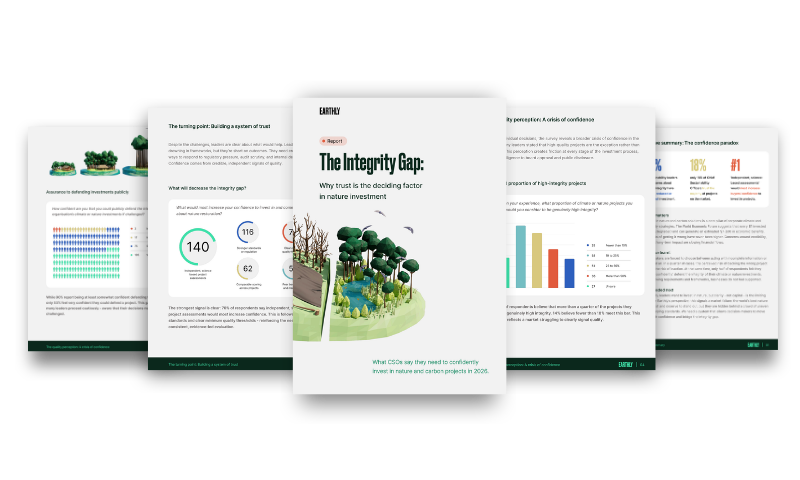
Decision-makers are forced to choose between acting with incomplete information or not acting at all. In a quarter of cases, the perceived risk of backing the wrong project outweighs the risk of inaction. At the same time, only half of the respondents felt they could ‘very confidently’ defend the integrity of their climate or nature investments. Despite growing requirements and frameworks, businesses do not feel supported.
What’s needed next from the market
Sustainability leaders want to invest in nature, but clarity - not capital - is the limiting factor. From Earthly's perspective, this signals a market failure: the world’s best nature projects exist and deserve to stand out, but they are hidden behind a crowd of uneven data and varying standards. We need a system that allows decision-makers to move forward with confidence and bridge the integrity gap.
Concerns about credibility are no longer theoretical - they are directly shaping financial decisions. For many organisations, integrity risk has become a gating factor, determining whether investment moves forward at all. This data shows that hesitation is not driven by lack of interest, but by fear of unintended consequences if projects fail to deliver on their claims.
Impact on investment decisions
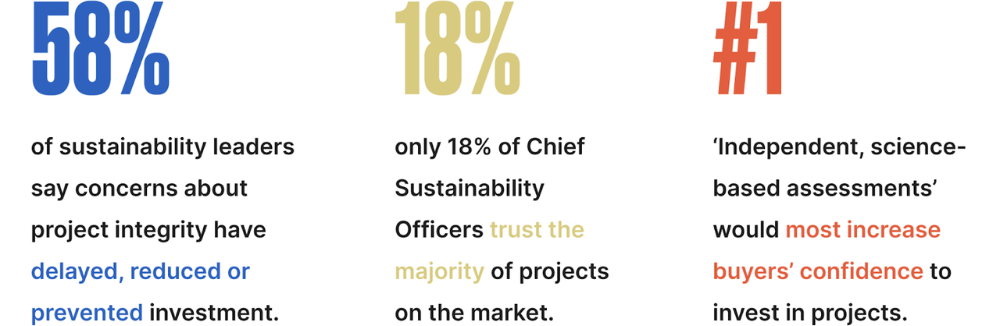
58% of respondents report that integrity concerns have either delayed, reduced, or completely prevented investment. Nearly 26% say investment was stopped altogether. This demonstrates a direct link between confidence and capital: when trust is missing, investment stalls.
Perceived risk comparison
When asked to compare risks, 56% of leaders see investing in a project that is later criticised as equally or more risky than doing nothing. This highlights the reputational pressure leaders face — and why many choose caution over action.

More than 90% of the 1,000+ nature projects Earthly has screened over the past five years fail to meet minimum quality standards. This highlights the need for rigorous, science-based assessment so businesses can identify credible projects and invest in nature with confidence.
Beyond individual decisions, the survey reveals a broader crisis of confidence in the market. Many leaders stated that high-quality projects are the exception rather than the norm. This perception creates friction at every stage of the investment process, from due diligence to board approval and public disclosure.
Perceived proportion of high-integrity projects
Only 43% of respondents believe that more than a quarter of the projects they assess are genuinely high integrity. 14% believe fewer than 10% meet this bar. This scepticism reflects a market struggling to clearly signal quality.
Assurance in defending investments publicly
While 90% report being at least somewhat confident defending their investments, only 53% feel very confident they could defend a project. This gap suggests that many leaders proceed cautiously - aware that their decisions may still be challenged.
Despite the challenges, leaders are clear about what would help. Leaders are drowning in frameworks, but they're short on outcomes. They need credible, low-risk ways to respond to regulatory pressure, audit scrutiny, and internal decision-making. Confidence comes from credible, independent signals of quality.
What will decrease the integrity gap?
The strongest signal is clear: 70% of respondents say independent, science-based project assessments would most increase confidence. This is followed by stronger standards and clear minimum quality thresholds - reinforcing the need for consistent, evidence-led evaluation.
The survey findings point to an integrity gap - but also to a clear path forward. Bridging this gap requires moving beyond fragmented standards and self-reported claims toward rigorous, science-based due diligence. When projects are assessed consistently across carbon, biodiversity, and social outcomes, decision-makers gain the clarity they need to act.
This is Earthly's role, and the latest evolution of our project assessment offers the most comprehensive methodology on the market.
is Earthly's independent project assessment framework, released in early 2026.
Keystone 3.0 evaluates nature and carbon projects across 168 indicators, covering climate impact, biodiversity health, and outcomes for local communities. Each indicator is supported by evidence and translated into an overall confidence score, allowing projects to be compared on a like-for-like basis, across registries and ecosystems, and supporting internal due diligence.
Rather than replacing existing registries and standards like the Integrity Council for the Voluntary Carbon Market's 'Core Carbon Principles', Earthly's assessment complements them - providing an additional layer of scrutiny that reflects how decisions are actually made and reduces exposure to reputational and regulatory risk.
By making quality quantifiable, Keystone 3.0 provides a structured audit trail; helps ensure that the world's most impactful projects are recognised, supported and scaled; and provides sustainability leaders the evidence needed for board and finance approval.

A community member involved in mangrove regeneration in Madagascar. Earthly assesses projects across carbon, biodiversity, and people to ensure nature investments deliver real impact on the ground.
are rapidly moving from voluntary sustainability initiatives to strategic business decisions. As expectations from regulators, investors, and stakeholders continue to grow, the ability to demonstrate the integrity and impact of nature investments will become important.
For businesses and sustainability leaders, this means strengthening due diligence processes, seeking clearer quality signals, and ensuring that nature investments can withstand scrutiny from boards, auditors, and the public.
brings together projects that have undergone independent assessment, enabling sustainability teams to explore opportunities aligned with their climate and nature ambitions and invest with greater confidence. You can also
if you would like to explore available projects or discuss how nature-based solutions can support your sustainability strategy.
Related articles
19.01.2026
Nature positive is a sustainable business approach that aims to actively reverse nature loss by restoring ecosystems, increasing …
)
04.12.2024
A set of rules for the carbon market have been accepted at the COP29 climate summit. What do …
)
05.10.2024
Plant species recovered from extinction through ecosystem recovery and restoration efforts …