A digital twin for every tree: blending innovation with natural processes is helping Luckaitz Valley flourish

A closed canopy of pine so dense that even natural regeneration needed assistance. How a forest in Germany is undergoing restoration that’s seen the return of wolves.

Jenny Hyndman

Jenny Hyndman

07 May, 2026

Loading...
A digital twin for every tree: blending innovation with natural processes is helping Luckaitz Valley flourish

Five years ago,

Luckaitz Valley

was an overstocked pine monoculture: closed canopy, bare floor, biodiversity at an all-time low. Today, young oaks and birch are knee-high in stands that have required thinning twice. We chatted to Pina Earth - the team behind the transformation - to find out what's driving that recovery: active management, a digital twin that models each and every tree, and a carbon credit structure that gives forest owners the financial buffer to think in decades.

TL;DR

  • Monoculture is a management problem, not a species problem. Open the canopy and nature recovers.

  • New trees have been thinned at least once in the last five years and natural regeneration is already visible.

  • The digital twin models individual trees, not averages, giving buyers full transparency on carbon storage.

  • Pine isn't the villain where it’s in demand by the community: existing stands can be managed while mixed forest establishes.

We’ve seen some great before/after photos from the Luckaitz Valley project, could you describe what the forest looks like today compared to when you started?

When the project began, the forest was a pine monoculture that carried years of deferred management. The younger age classes were behind on thinning, the stands were overstocked, and large parts of the forest floor were covered in nothing but brown pine needle litter and moss. The prevailing philosophy had been "touch as little as possible". Five years in, the picture has changed substantially. Every single management unit has been thinned at least once, and several have already seen a second intervention. Within ten years, every hectare will have been worked twice. Compared to the previous regime, that roughly doubles the intensity of tending and thinning. This matters because overstocking was the root problem. As long as the pine canopy stayed closed and the backlog sat untouched, other tree species had no chance to establish. Now that the stands are opened up, natural regeneration is already showing up: birch, oak, pine, and even some Douglas fir are coming in across the treated areas.

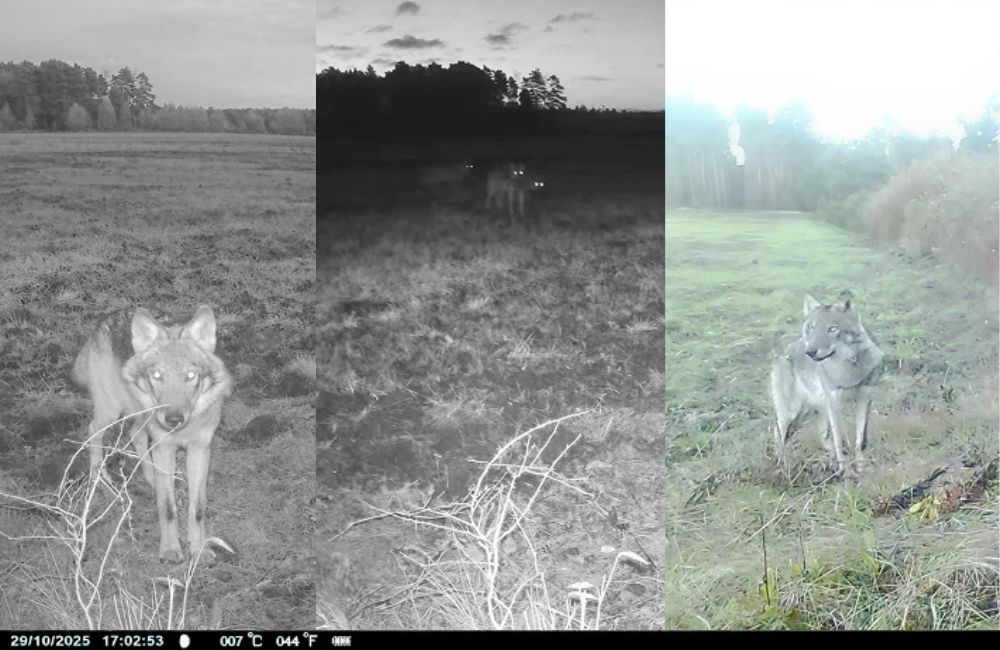
Wolves from trail cameras at luckaitz forest

Trail cameras captured the activity of the local wolfpack which is having an effect on grazing happening in the forest.

The project aims to go from one main species (pine) to five. Which species have established themselves most successfully so far, and which have been harder to integrate?

Active planting has not actually started yet. Everything visible so far is natural regeneration, and active planting only happens where the overstory is open enough to let young trees survive. The first active plantings go in this autumn: silver fir, plus sweet chestnut as a climate-resilient broadleaf within the deciduous mix. Before that, years of missed thinnings had to be caught up on to create the growing space. Among the species coming in naturally, birch is leading the way. As a pioneer species it establishes quickly and helps regulate the species composition. Oak is also coming up readily, which fits the site: sessile oak belongs to the natural forest community in this region. Oak is also the hardest species to integrate, for one reason: browsing pressure. Roe deer browse young oak heavily, and it carries the biggest browsing load of any species in the project. A wolf pack with young has moved into the valley, which is ecologically positive but makes hunting more difficult. The deer avoid the wolves and move unpredictably, reducing how effectively numbers can be brought down. Even so, browsing has been pushed down far enough that oak is no longer being prevented from coming up. From a silvicultural standpoint the damage is under control, even if it is not yet where the project wants it to be. For the autumn planting of fir, individual tree protection is under consideration. It works, but it comes down to cost. 

You work closely with the forest owners - how has this project changed the way they think about and manage their land? Have any of them surprised you with how they've responded?

The biggest shift in Luckaitz is the level of structure the project brought with it. Before, the plan was more open: manage the stands, thin them, and see what nature does over the first ten years. Now target species are defined and the time frame is binding. Silver fir and sweet chestnut, for example, go in this autumn as part of that commitment.

A second shift is how much more the forest is being invested in. Tending spend has reached well into the five figures in each of the last two years, amounts that would not normally be committed under standard conditions. The project creates the financial buffer that makes this kind of reinvestment possible, and that willingness to put money into species mixing, regulation, and stand quality is the real behaviour change. Eike, the forest owner and manager, had been thinking along similar lines for some time, which is what made the collaboration work from the start. The project gave those intentions a clear framework and the financial backing to act on them at pace.

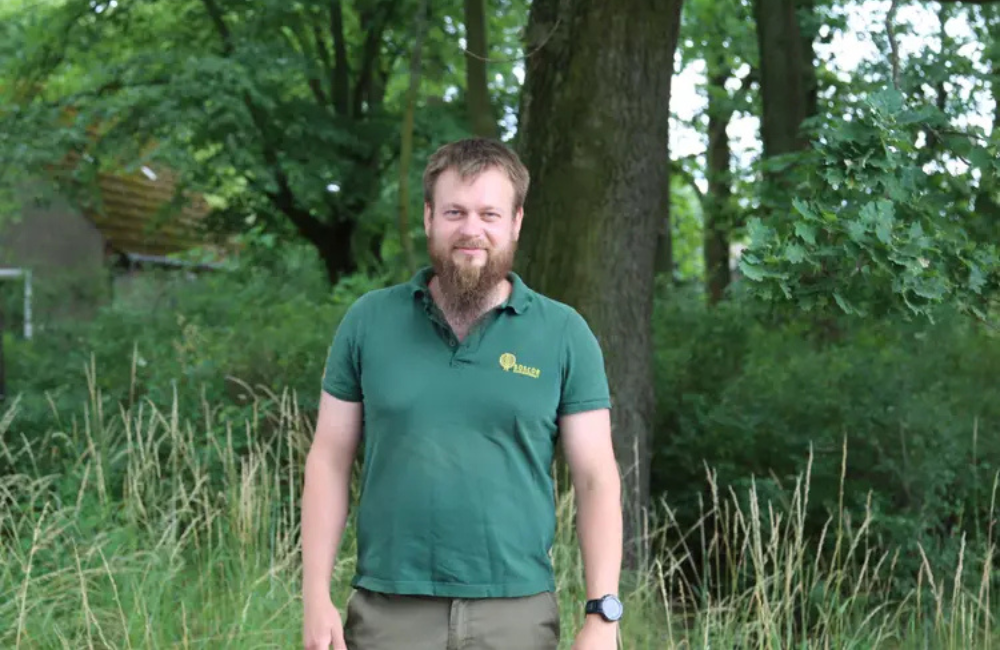
Eike Hornsmann", and his role is "Forstingenieur und Revierleiter im Forstbetrieb Luckaitztal"

Eike Hornsmann, Forestry engineer and district manager in the Luckaitztal forestry operation

German forests are publicly accessible by law. Have you seen or heard from local communities about the difference in the forest now?

Yes, and the reactions are mixed, which is itself a useful data point. Residents have clearly noticed that something is happening in the forest every year. That is new for them. Under the old regime of "doing only what is absolutely necessary," years could pass without visible activity. Now, with a sustainable harvest plan running, interventions are regular. Some locals find that unsettling. "He's making timber again" is a common reaction. Eike handles it in conversation, on the spot. The comparison he uses with walkers, "do you only plant your field every third year?", tends to land. People understand the logic quickly once they see it. But there is a background assumption in Brandenburg that modern forest management is something to be suspicious of, and that takes patient one-on-one explanation.

Has anything surprising happened at the project: a challenge; a faster-than-anticipated recovery; a certain reaction; or an ecological phenomenon you weren't expecting?

The most striking observation has been the speed of natural regeneration once the canopy was opened. In one recently treated stand, young oaks had already come up to knee height. In other comparable projects, that kind of establishment can take three years. Luckaitz has lower deer density than many similar sites in the region, which clearly helps.

Pine monocultures are under scrutiny across Germany and Europe. What do you think the broader forestry sector has misunderstood about what it takes to transition away from monoculture, and what has Luckaitz taught you about that? 

The dominant narrative treats pine itself as the problem. From what we see across our project portfolio, that framing misses the point. Pine is a native species in much of Germany and performs well on the right sites. The real issue is what happens when stands are left overstocked and unmanaged for decades: the canopy stays closed, light does not reach the forest floor, and no other species can establish. Monoculture is a symptom of management choices, not of the species.

A second misunderstanding is treating conversion as purely a forestry problem. It is also an economic one. For decades, doing nothing was the rational choice in many pine regions because sawmills reliably bought what forest owners harvested, and there was no price signal pushing for diversification. That is changing. Since 2025, pine prices have risen, demand is strong, and several large sawmills that used to focus on spruce are buying more pine simply because spruce is no longer available in the volumes they need. Forests with reliable supply and short decision chains benefit disproportionately in this environment.

What Luckaitz has reinforced for us is that conversion only works when all three conditions come together: open, actively managed stands that give young trees a chance; a market that values what comes out of the forest in the transition; and a forest owner with the patience and the financial buffer to think in decades rather than rotations. Remove any one of those and the transition stalls, which is why a lot of well-intentioned public rhetoric about "getting rid of monocultures" has not translated into change on the ground. Pine itself also deserves a more nuanced conversation. It carries a roof truss just as well as spruce: the structural performance is comparable, and processing is largely the same. There is a lot of room to use existing pine stands more intelligently while the next generation of mixed forest grows up underneath them.

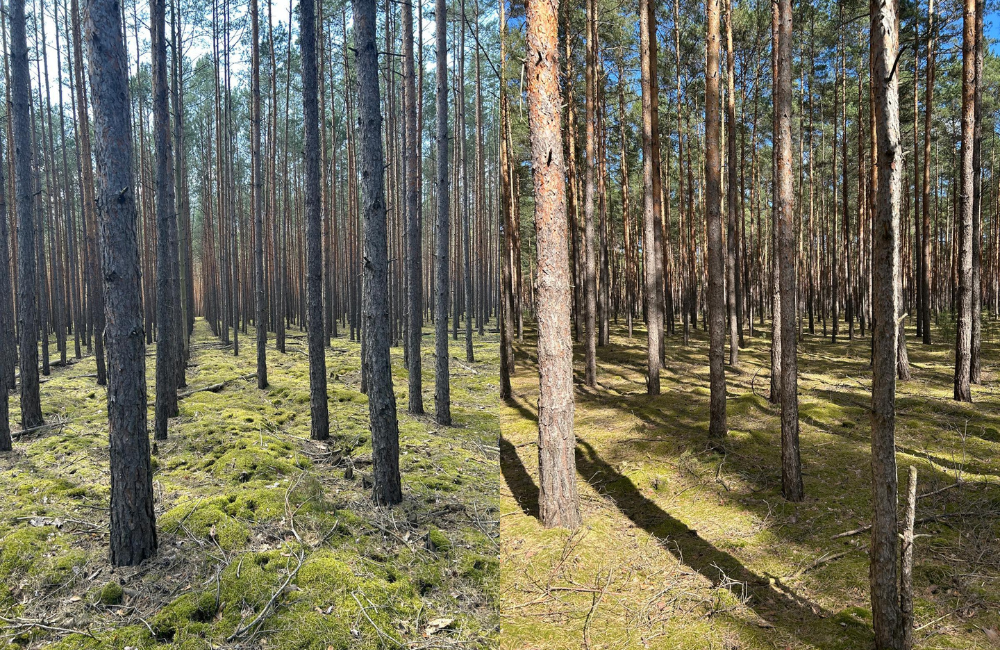
Before: Luckaitz forest floor with poor biodiversity

The 'before': Natural mortality is setting in here. The trees have grown up very densely in this stand, with very small crowns. The absence of past interventions (stem number reduction) has resulted in unstable stands, particularly vulnerable to storm damage.

The 'Digital Twin' system Pina Earth is using sounds fascinating! Can you explain the ‘digital twin’ concept in plain language: what is actually being simulated, and how does it differ from how carbon storage or biodiversity benefit is typically measured in forest projects?

A digital twin of a forest is a computer model of every tree in the project area. We build it from the forest owner's own inventory data, which owners maintain anyway for tax purposes, and we harmonise that data so our simulation software can work with it. For each stand we know the species mix, the average age, and how well different species have grown on that specific site over the past hundred years. From that, the simulation generates individual trees, each with its own species, size, and precise location. Once the twin exists, we run it forward in time, usually over thirty years, in five-year steps. In each step, trees grow, some die from climate stress, some get harvested or thinned, and new ones come in through planting or natural regeneration. The growth functions, mortality models, and regeneration dynamics behind these steps all come from peer-reviewed forest science, built on decades of published research on how specific species behave under specific site conditions. We always run two scenarios in parallel: a baseline that reflects what standard practice in neighbouring forests would produce, and a project scenario with the changed management plan. The delta between the two is what we can issue as credits. The contrast with most forest carbon projects comes down to the unit of measurement. Many projects rely on sample plots, area averages, or fixed expansion factors. That works for broad estimates, but it smooths over everything that makes a specific forest behave the way it does. Our simulation works at single-tree resolution, which means it can capture species interactions, how a thinning in one period affects the growing conditions for the generation underneath, and how changes in species mix compound over decades. Combined with the scientific foundation of the underlying equations, that level of detail is what gives us the transparency to show buyers exactly where the climate benefit comes from and how it develops over time.

What does the individual tree simulation enable that wasn't possible before? How does it change the confidence you have in the CO2 storage figures you present to buyers?

The most practical gain is the ability to test management decisions before they happen in the forest. We can model what happens if we accelerate harvesting in the first five years to open the canopy, when planted oaks reach the point where they shade out competitors, or how a shift in species mix compounds over thirty years. Each of those questions has a different answer depending on the specific stand. Aggregate methods flatten that detail; single-tree resolution preserves it, which means we can iterate on the management plan itself rather than just estimate its outcome. This also changes the conversation we can have with forest owners. Instead of presenting a single projected number at the end of a long process, we can show how specific silvicultural choices drive the result, and adjust them together if something does not look right. The twin becomes a shared planning tool, not just a reporting instrument. For buyers, confidence comes from two things the simulation does by design. Randomised parameters mean every scenario is run multiple times and the reported figures reflect the range of plausible outcomes, not a single point estimate. And because the simulation tracks each cohort of trees individually, we can show buyers where the carbon actually sits today and how it is expected to develop over the crediting period, tree by tree. That moves the conversation from "trust us, it adds up" to something a buyer can interrogate end to end.

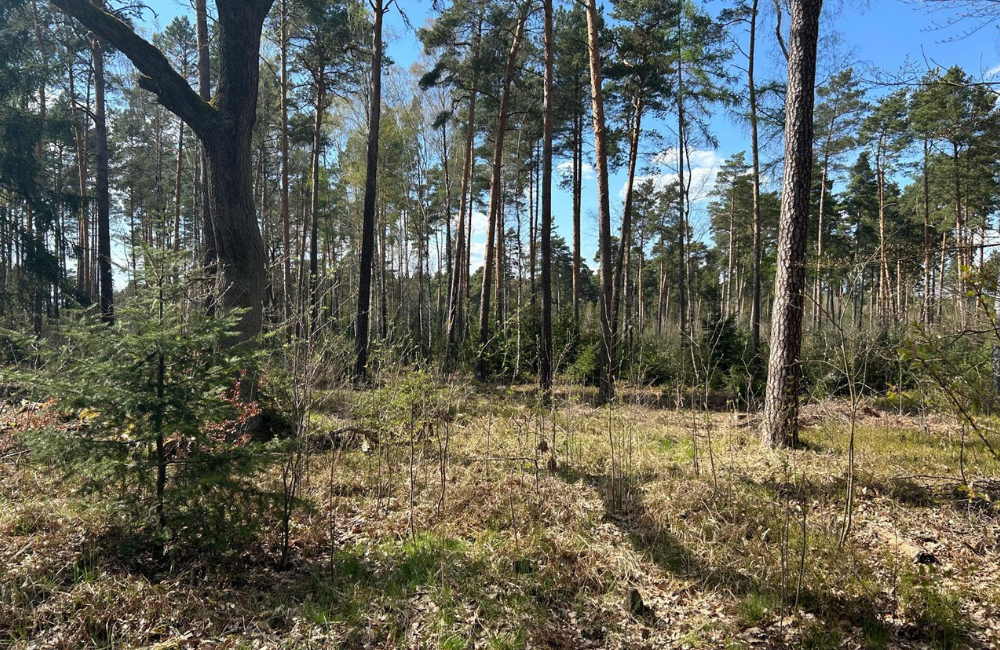
Luckaitz forest floor and biodiversity recovery

The 'after': Active interventions have taken place here. Timber has been removed, light now reaches the forest floor, and the trees regenerate naturally (no planting here). A few individual oaks are already enough to provide the next generation, and Douglas fir also regenerates on its own in these spots.

Where do you see the digital twin technology going - is this something that could eventually be applied to other forest types or geographies?

Yes, and we're already moving in that direction. The approach is fundamentally transferable. What changes between forest types is the calibration, not the method. DACH is our starting point because that's where our data foundation is strongest. Extending to other regions is technically demanding and requires careful groundwork, but it's within reach, and we're working with established research partners on this. The more interesting horizon is how the twin connects to the rest of the carbon market. Higher resolution opens the door to more dynamic monitoring, faster recalibration, and tighter integration with remote sensing. That's the direction we think forest carbon accounting needs to go.

Support this project through Earthly

We know that for many sustainability leaders, the hardest part of investing in nature is finding something you can genuinely stand behind when the

project credibility questions

get difficult. This project was built to meet that level of scrutiny - with the structure, verification, and transparency to stand up to it.

If you are building your nature strategy for the first time, this is an exceptional place to start. If you are deepening an existing portfolio with projects that can carry real reporting weight, it fits perfectly in your nature and climate action.

You can explore the

project and its full impact on our page

to see the verified outcomes, Earthly rating and project detail.

If you would like to talk through this project, or get a tailored portfolio of nature investments that could support your climate and nature commitments, please

get in touch with the Earthly team