26.09.2024
Partnering with a future-focused bank
Launched in January 2016, imagin has already reached more than a million customers. They are Spain’s …
)
Digital sampling platform
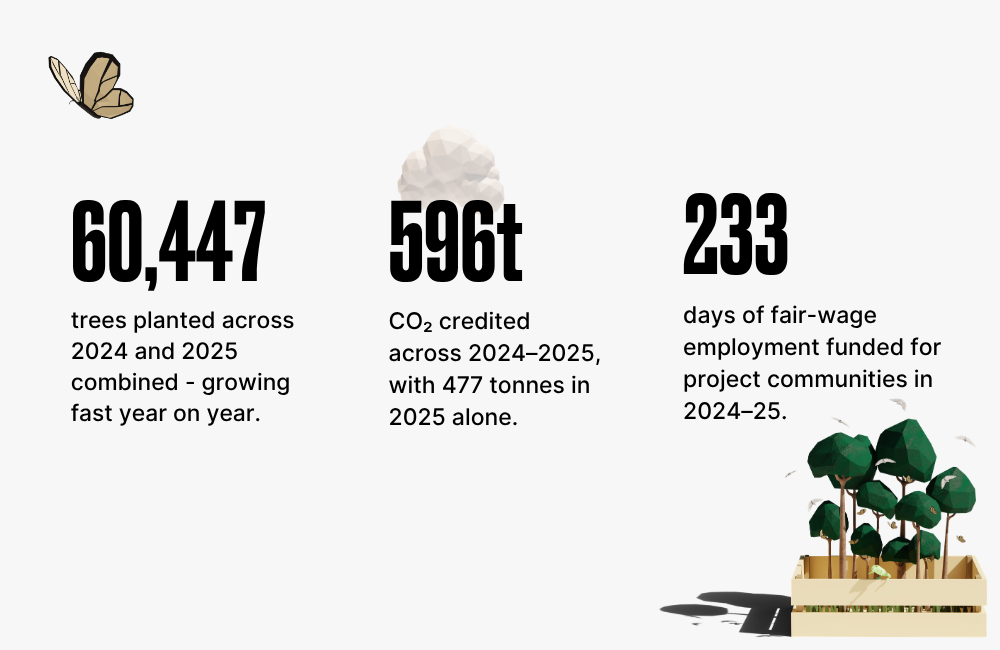
has transformed what could have been an unavoidable carbon liability - the physical shipping of product samples to consumers - into a measurable, data-backed force for nature restoration. The approach works on two levels: first, by dramatically cutting the number of samples that should never have been sent in the first place, then by embedding Earthly's nature-based solutions into every campaign that goes out. The result is a sustainability model that gets more impactful as the business grows - from 12,160 trees planted in 2024, to 48,287 in 2025, with a long-term ambition of 1 million trees and 10,000 tonnes of CO₂ overcompensated.
Sampl reduces waste first by filtering >40% of sample requests before fulfilment.
The remaining footprint is offset via Earthly: 1 tree per 100 samples, 1 tonne per 10,000.
The number of trees planted has grown nearly 4x year-on-year.
8,150 were mangroves planted in April 2025 alone - removing 81 tonnes of CO₂.
Long-term ambition: 1 million trees and 10,000 tonnes of CO₂ overcompensated.
Somewhere today, someone walking through a train station will be handed a product they didn't ask for. A can of something. An energy bar, a sachet of shampoo, a single-serve coffee. They'll take it out of politeness, glance at it, and bin it before their train pulls in.
That sample was made in a factory, packaged, shipped across the country - and it landed with someone who was never going to buy it. Multiply that by every unsolicited sample handed out, posted, or dropped into a goody bag across the UK in a single week, and it stops looking like a small thing. Sampl decided that wasn't an acceptable model.
Every untargeted sample carries two costs at once. Commercially, a free product sent to someone who was never going to buy produces no purchase, no review, and no marketing opt-in worth having - the spend is simply written off. Physically, the same sample was still made, packaged, and moved. Raw materials, energy, and fuel were spent on a journey that was never going to matter.
Traditional sampling normalised this trade-off. Campaigns often stop at distribution: nobody tracks what happens next, so nobody counts the waste on either side. The physical cost of the model is treated as unavoidable - just the price of doing business at scale.
For a company working towards B-Corp certification and positioning itself as a responsible partner to brand clients, that argument isn’t good enough. The question wasn't whether to act - it was how to act credibly, not just a tick-box exercise. In a market increasingly scrutinised for greenwashing, Sampl needed nature investment that could withstand client and stakeholder scrutiny.
Sampl supports the Highland Restoration project in Ethiopia - contributing to large-scale ecosystem restoration, community support, and long-term climate impact through verified nature-based solutions.
Sampl's
starts before a single sample is packed. Its proprietary targeting technology, SamplMatch, pre-filters every sample request to ensure that samples only reach real, interested consumers - filtering out freebie hunters, duplicates, fraudsters, and low-intent consumers before fulfilment. In 2025, that meant more than 40% of all sample requests across the platform were filtered out. That's more than 40% of samples that didn't need to be produced, packaged, or shipped.
The commercial logic and the environmental logic point in the same direction: the sample that doesn't travel to the wrong person saves money, generates cleaner data, and avoids a footprint that didn't need to exist. Reducing waste this cycle also improves targeting next cycle - clean opted-in data from real consumers means the next campaign starts with a better audience, which means fewer wasted samples again. It's the compounding opposite of how traditional sampling works.
The Clarins Re-Move campaign is a case in point. Clarins came to Sampl having seen previous online sampling end up on freebie sites - samples reaching people with no intention of buying the product. By targeting Clarins' own Facebook audience and running every sample request through SamplMatch, more than 40,000 requests were filtered out.
Those 40,000+ samples were never made up for dispatch, never packed, never loaded onto a van. The samples that did go out reached genuinely interested consumers: 77% reported purchase intent afterwards, 95% said they'd recommend the product, and 60% opted in for future marketing.
Even with strong targeting, a more efficient campaign isn't a zero-footprint campaign. The samples that do get sent still have a physical cost. Rather than purchasing credits retrospectively as an afterthought, Sampl embedded Earthly's nature-based solutions directly into its core business model. The formula is precise and scalable: for every 100 samples shipped, one tree is planted; for every 10,000 samples, one tonne of carbon credits is purchased. That structure means every campaign automatically carries a proactive nature contribution, proportional to its footprint - not calculated annually after the fact.
Through Earthly's platform, Sampl accesses a portfolio of high-integrity projects - from
to
- each assessed against Earthly's
. Keystone 3.0 evaluates over 160 evidence-based indicators across carbon, biodiversity, and people; fewer than 9% of projects assessed reach Earthly's minimum integrity standard. That rigour matters enormously for a company building its sustainability claims on solid ground.

Each of Sampl’s campaigns contributes to real, verified outcomes across ecosystem restoration, carbon impact, and community support through Earthly’s nature-based projects.
The growth in Sampl's impact tells its own story. In 2024, the partnership funded the planting of 12,160 trees and credited 119 tonnes of carbon. In 2025, those figures jumped to 48,287 trees and 477 tonnes - a near four-fold increase in a single year, driven purely by campaign volume scaling. That's the power of a model that is tied to activity rather than set at a fixed annual figure: as Sampl grows, so does its nature contribution, automatically.
The proudest milestone so far? In April 2025 alone, Sampl funded the planting of 8,150 mangroves - enough to cover 12 football pitches. Those mangroves will sequester an estimated 81 tonnes of CO₂ over their lifetime: the equivalent of driving a car around the earth eight times! That's not an abstract claim. It's a documented outcome, traceable to a specific project, in a specific location, in a specific month.
Alongside the carbon and tree figures, the partnership has generated 233 days of fair-wage employment for communities working on the projects. It's a reminder that nature-based solutions done properly aren't just about carbon - they're about the people living and working alongside the ecosystems being restored.
The outcomes go well beyond Sampl's internal sustainability reporting. Via Project Credit Account (PCA) reports, Sampl's clients receive precise, campaign-level data on the trees planted and carbon credits generated on their behalf - concrete numbers they can incorporate into their own ESG reporting cycles, align with net zero targets, and communicate with confidence to investors and consumers. Brand ESG targets are met with evidence rather than estimates, and the nature-positive story adds genuine differentiation in a competitive marketplace.
"We chose Earthly for their transparent, high-impact nature-based solutions. The platform is incredibly intuitive, providing data along with supporting imagery. We need to show off our real-world impact. Their close connection to projects makes our sustainability journey feel real, rewarding, and inspiring."
Betsy Wells, Delivery Manager - Sampl
Sampl's decision to work with Earthly was shaped by one central requirement: the credibility to represent their sustainability impact honestly. In a landscape still clouded by vague carbon claims and unverified offsetting, Earthly's transparent standards and rigorous project verification provide something genuinely rare - data-led confidence that holds up to external scrutiny.
The partnership is framed not as offsetting, but as something more ambitious: proactive restoration. By investing across diverse ecosystems - mangroves in Madagascar, agroforestry in Kenya - Sampl is building a nature-positive legacy that scales with its business. Nature-based solutions are estimated to contribute up to 30% of the climate mitigation needed to stabilise the planet. That's why Sampl backs this category rather than pure carbon offsetting: it's not just about neutralising what already happened, it's about actively restoring what matters.
The long-term ambition is clear: to plant 1 million trees and overcompensate for 10,000 tonnes of CO₂. The 2024 and 2025 figures are the starting point - real, accountable numbers that compound as the business grows. At the current trajectory, the target isn't a pipe dream; it's a plan.
The operational support from Earthly's team has also proved essential. For a business integrating sustainability reporting into its client-facing workflow, a seamless process matters as much as the projects themselves. Earthly's customer team made that integration straightforward - removing friction and ensuring that staff can communicate impact with accuracy and ease.
Whether you're building a sustainability programme from scratch or looking to strengthen an existing one, Earthly's team would love to help you find the right nature-based solution.

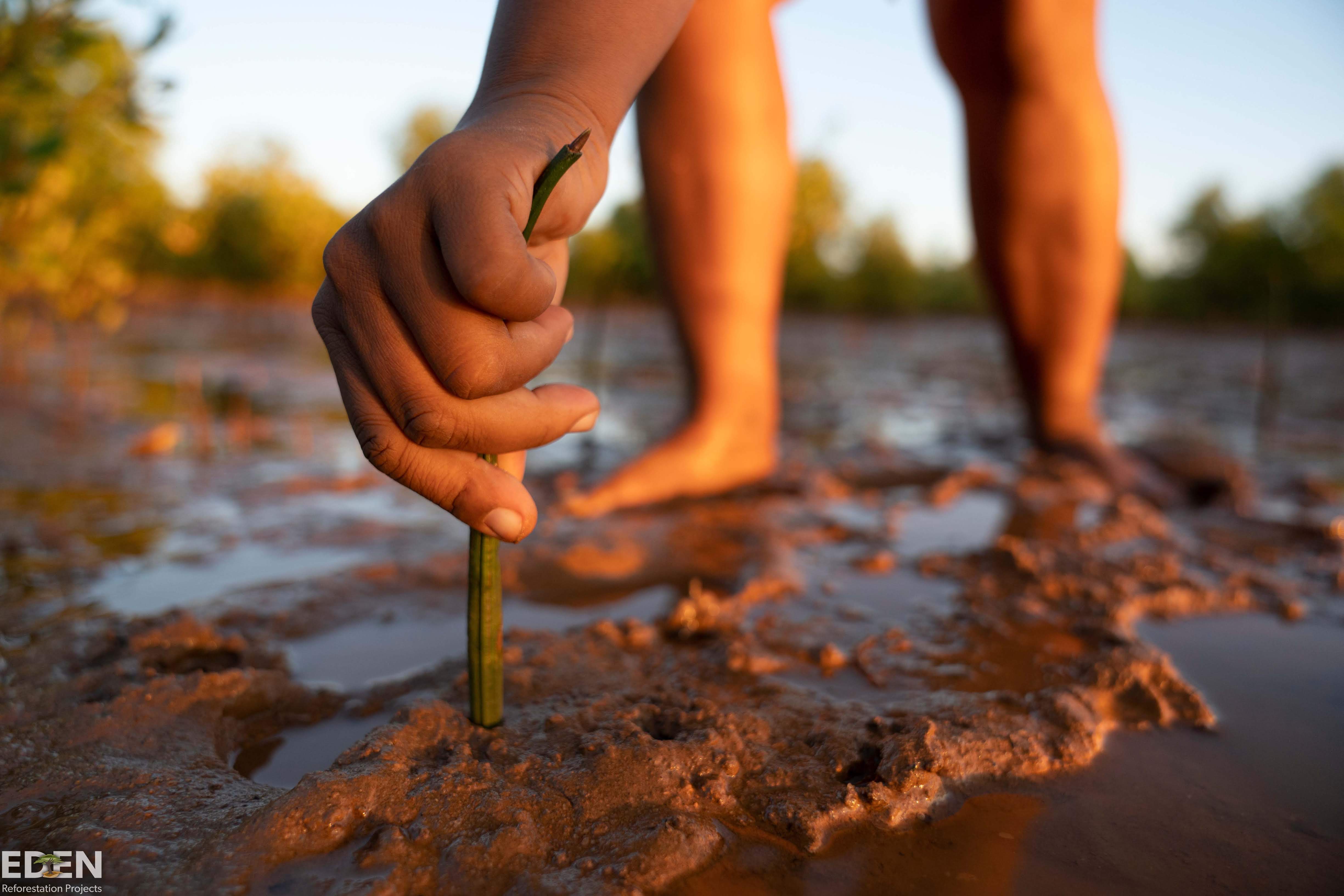
Ongoing mangrove restoration in Madagascar, supported by Sampl. Mangroves store up to four to five times more carbon than most land-based tropical forests, while protecting biodiversity and coastlines from erosion, storms, and sea-level rise.
What are mangrove-based carbon credits, and why do they matter?
Mangrove carbon credits represent verified tonnes of CO₂ sequestered through mangrove protection or restoration. Mangroves store up to five times more carbon per hectare than tropical forests, while providing coastal protection, supporting biodiversity and sustaining local fishing communities - making them one of the highest-impact ecosystems to invest in.
What is agroforestry, and how does it support carbon removal?
Agroforestry integrates trees into agricultural land so that food production and carbon sequestration happen simultaneously. In Kenya, the projects we work with restore degraded landscapes, improve soil health, and increase biodiversity - while generating verified carbon credits as trees grow and delivering meaningful economic benefits to local farming communities.
How does Earthly verify the quality of its nature-based projects?
Earthly's proprietary Keystone 3.0 framework assesses every project across 160+ evidence-based indicators covering carbon integrity, biodiversity, and social outcomes. It draws on geospatial analysis, third-party carbon ratings, and legal due diligence. Fewer than 9% of projects screened meet Earthly's minimum standard - so only the highest-quality projects reach the platform.
How does embedding carbon credits into a business model differ from buying offsets?
Traditional offsetting is generally retrospective: credits are purchased after emissions are calculated. Embedding credits means nature contributions happen automatically, proportional to business activity. For Sampl, every 100 samples triggers a tree planting and every 10,000 triggers a tonne of credits - sustainability built in, not bolted on.
Related articles