"I attended to two flagship nature events in March. The
Villars Institute Summit
in the Swiss Alps, and
Landed
from Founders Forum on a working farm in the Cotswolds. Different audiences, different agendas. Villars was institutional capital, policymakers, and the heads of the global frameworks. Landed was farmers, founders, bankers, and clinicians.
Across roughly twenty hours of conversation between the two, the word I barely heard was "sustainability."
According to The Nature Conservancy and Forest Trends' 2026 report, nature investment has grown fivefold in a decade, from $2.8B to $14B a year, with $180B more on the way. But as more businesses invest in nature, how can they be confident those projects are delivering real outcomes?
The language has shifted: Across two flagship nature events, "sustainability" and "ESG" were barely mentioned. Instead, the conversation was held in the language of finance: material, risk, capital allocation, actuarial, balance sheet.
The buyer has changed: Nature is now being paid for by procurement leads, risk officers, insurers, and pension funds, not sustainability teams with discretionary budgets. That shift changes what they need to see before they'll pay.
The frameworks are largely in place: TNFD, SBTN, CSRD, UK BNG, and ISASB's new sovereign asset category mean the toolbox already exists. The open question has moved from "is there a framework?" to "can we trust the outcome?"
Verification is the layer that unlocks scale: A five-year soil carbon study found a 25x variance in outcomes between farms following identical practices, showing that practice-based attestation alone can't predict real results. Third-party, evidence-grounded verification is what turns good intentions into bankable claims.
Demand is outpacing supply: Buyers like Microsoft, Diageo, and major pension funds are already moving faster than the verification infrastructure can keep up, creating a clear opening for platforms that can credibly stamp quality at scale.
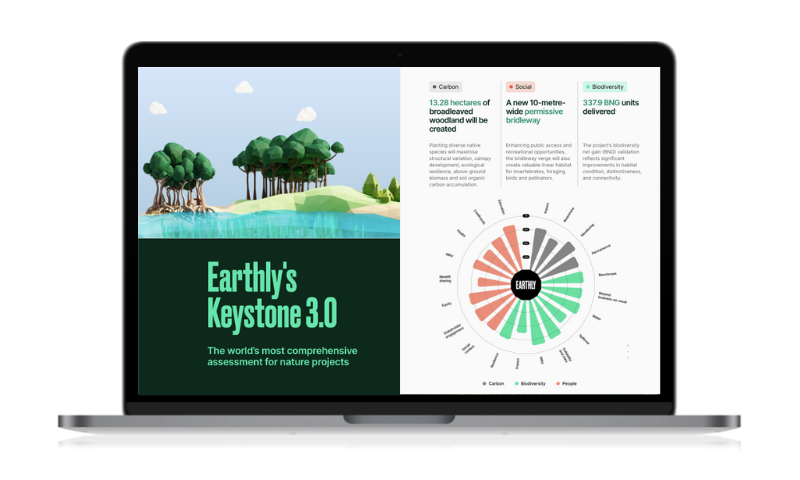
This is where Keystone fits: Built to answer the one question that matters at the point of transaction: is this project credibly delivering what it says, and will it hold up under real scrutiny.
Nobody really used "values" either. "ESG" came up twice that I can remember: both times as a problem to be worked around. What I did hear, repeatedly, from very different people was:
material, risk, capital allocation, actuarial, infrastructure, balance sheet.
A senior CSO at a global industry said her board switches off the moment biodiversity is raised in moral terms. A senior infrastructure banker framed nature as the missing layer in actuarial modelling. A long-tenured sustainable investor said you can't build financial instruments at scale unless you can show outcomes, properly.
If I'm honest, the substance didn't surprise me - the vocabulary did. The grown-up conversation about nature has started, and it's being held in the language of finance, risk and materiality. Not the language we've spent a decade training corporates to speak.
That shift matters. It changes who the buyer is. It changes what they're buying. And it changes what the people building this market need to put on the table.
The most useful thing I took from both events was a clearer picture of who actually pays for nature now. It isn't a sustainability team with a small discretionary budget. It's a procurement lead worried about supply chain disclosure becoming compulsory. A risk officer modelling flood exposure across an infrastructure portfolio. A Real Estate Investment Trust (REIT) trying to price tree canopy uplift into property values. A pension fund deploying place-based capital under the Mansion House Accord. An insurer staring at a sixth consecutive year of $100bn-plus insured natural catastrophe losses.
These people don't speak the language of impact. They speak the language of liability, dependency, and material risk. When a CFO uses the word "material," they don't mean it the way a sustainability report means it. They mean it the way an auditor means it. And the moment a procurement function classifies nature loss as material, regulators and auditors follow.
What's interesting is that the supply chain to those buyers is fundamentally different from the one Earthly, and most of our peers, have spent the last decade building. The volume isn't sitting with the sustainability community that made the early voluntary market. It's sitting with the people whose actuarial models have broken.
According to Earthly's CSO survey, 58% of sustainability leaders say concerns about project integrity have delayed, reduced or prevented investment.
The second pattern was more striking the more I listened to it. Multiple speakers, from radically different parts of the value chain, kept circling the same conclusion: the frameworks exist. TNFD has 750-plus adopters representing $22 trillion in AUM. SBTN is rolling out V2 land targets this year. CSRD is in force. UK BNG is live. ISASB has just approved nature as a category of national asset for sovereign balance sheets from 2028.
The toolbox is, broadly, built. What people kept saying, in different words, is that the binding constraint has now moved. It's no longer "do we have a framework?" It's "can we trust what's coming out the other side?"
A long-tenured sustainable investor put it on stage at Landed almost word-for-word the way we've been pitching Keystone for two years: if you can't show what you've actually delivered, you can't build financial instruments to scale. An operator on the same panel admitted he'd paid two credible firms to measure the carbon footprint of a kilo of lamb, an egg, and a litre of milk, and got back two completely different sets of numbers.
This is the gap. It isn't capital. It isn't intent. It isn't even framework coverage. It's the absence of trusted, independent verification at the layer between project and balance sheet. We've screened over a thousand nature projects through Keystone's 168 indicators, and fewer than 9% pass. That number used to feel uncomfortably low to share. After the last month, it feels like the most honest data point in the room.
The single most decisive data point of the month came from a publicly-cited study that tracked carbon sequestration on a set of First Milk dairy farms over five years using deep one-metre soil cores. The best farms sequestered 25 tonnes of carbon per year. The worst sequestered one tonne. Same practices on paper.
A 25× outcome variance on identical practice descriptions is the empirical end of practice-based attestation as a serious verification model. You cannot build a market on "this farmer ticked the right boxes." The boxes don't predict the outcome. The same conclusion was reached in the Villars conversations, just from a different direction. Companies are sceptical of frameworks that rely on self-attestation. Regulators are moving toward outcome-linked metrics. The science community is publicly walking back some of the headline claims of the last decade, and the Trillion Trees backlash sat in the background of more than one panel.
What replaces practice-based attestation is outcome-based, evidence-grounded, third-party verification. It is also, not coincidentally, more expensive and harder to do well. Which is exactly why the moat in this space is moving up the stack toward interpretation and integrity, and away from raw data collection. Soil biology testing dropped from over £200 per sample to £25 in the last 18 months. eDNA platforms are cheaper every year. Bioacoustics is scaling. Data is commoditising. What stays scarce is the layer that turns data into a defensible answer.
Only around 10% of projects screened by Keystone make it onto the Earthly Marketplace. Every project is independently assessed across carbon, biodiversity, and people outcomes, helping businesses invest in projects that can deliver credible, verifiable outcomes.
The third pattern, and the one with the most commercial energy behind it, is that the buyer side is already moving. Across two sessions at Landed alone, the named offtakers in the room included Microsoft, Diageo, Burberry, the Sustainable Markets Initiative, Morrisons, and the world's largest beer producers. At Villars, the demand-side pressure was if anything more institutional. The Singapore carbon tax with a 5% nature-based offset allowance. UK BNG mandatory for nationally significant infrastructure projects from May. Pension fund seed capital deploying into landscape-scale resilience contracts. Sovereign wealth funds publishing nature stewardship principles.
The buyer is moving faster than the verification supply. That's a market dynamic with a particular shape. It rewards anyone who can credibly stamp quality at scale. It punishes anyone whose claim depends on self-grading. And it puts genuine pressure on the platforms that have been building integrity capability in-house: at some point, infrastructure-grade counterparties will want a third-party rail.
If you'd asked me a few years ago whether we'd be having this conversation now, I'd have said optimistically by 2028. The market is now where I hoped it would be then.
Pulling the threads together: the language has changed, the buyer has changed, the framework conversation is mostly settled, and the binding constraint has moved to integrity and outcome verification. None of that is comfortable for anyone whose business model depends on practice-based attestation, self-grading, or sustainability-team budgets. All of it is good for the businesses that have been quietly building infrastructure for the moment the market grew up.
That's why we built
Keystone
. Not as another framework. Not as a competing scoring system. As the layer that takes the frameworks the world already has and answers the only question that actually matters at the point of transaction: is this project credibly delivering what it says it's delivering, and would it survive the kind of scrutiny that comes when nature shows up on a balance sheet?
Two flagship events, one word nobody used, and a pretty clear message about where this market is heading. The grown-up conversation has started. The next twelve months are about who can speak its language fluently.
Procurement teams, risk leaders, and investors must demonstrate that nature investments deliver measurable outcomes. That means choosing projects backed by independent, evidence-based assessments.
The Earthly Marketplace connects businesses with
Keystone-assessed
nature projects that have undergone rigorous evaluation for carbon, biodiversity, and social outcomes, helping you invest with greater confidence.
Browse our
marketplace
or
speak to our team
about building a high-integrity nature portfolio.
Keystone is a nature project assessment framework that evaluates every project against 168 science-based indicators, scoring it on maturity (how well it meets the assessment criteria) and confidence (the strength of the evidence behind its claims). It is also methodology- and registry-agnostic, comparing projects across different standards, ecosystems, and geographies.
Why has the language around nature investment shifted from sustainability to risk?
Buyers of nature-based outcomes have changed. Procurement leads, risk officers, insurers, and pension funds are now the ones paying, and they operate in the language of material risk, liability, and capital allocation rather than impact or values.
What does "materiality" mean in the context of nature?
Materiality refers to environmental issues that could have a big impact on a company's financial performance or business operations. When biodiversity loss is considered material, businesses are expected to identify, assess, manage, and disclose those risks.
Why isn't having a framework enough?
Frameworks such as TNFD, SBTN, CSRD, and UK Biodiversity Net Gain provide guidance on measuring and reporting nature-related impacts. However, businesses also need reliable, independent evidence that projects are delivering the outcomes they claim. Without trusted verification, reporting and investment decisions become much harder.
Why doesn't practice-based attestation work as a verification model?
Practices alone don't predict outcomes, which is why outcome-based, evidence-grounded verification is replacing self-attestation.
How does Keystone address the verification gap in nature markets?
Keystone works alongside existing frameworks rather than replacing them, answering the specific question buyers need answered at the point of transaction: is this project credibly delivering what it says, and would it survive scrutiny once nature shows up on a balance sheet?

)


)
)
)